Pairwise
Comparison Method In the pairwise comparison method
of voting, the voters rank the candidates. The method consists
of a series of comparisons in which each candidate is compared
to the other candidates. If choice A is preferred
to choice B, then A receives 1 point. If B
is preferred to A, the B receives one point.
If the candidates tie each receives 1/2 point. The candidate
with the most points wins.
Parabola A set
of points in the plane equidistant from a given point (called
the focus) and a given line (called the directrix). It is
the path of a projectile. The axis of symmetry is the axis
of the parabola. The point where the axis cuts the parabola
is the vertex.
Parallel circuit
Two switches connected together so that if either of the
two switches is turned on, the circuit is on.
Parallel lines
Two nonintersecting straight lines in the same plane.
Parallelepiped
A polyhedron, all of whose faces are parallelograms.
Parallelogram
A quadrilateral with its opposite sides parallel.
Parentheses
See Grouping symbols.
Pareto principle
If each voter prefers A over B, then the group
chooses A over B .
Partial sum
If s1, s2, s3,
... is a sequence, then the partial sums are S1
= s1, S2 = s1
+ s2 ,
S3 = s1 + s2
+ s3, ...
Pascal's
triangle
A triangular array of numbers that is bordered by one and
the sum of two adjacent numbers in one row equal to the
number in the next row between the two numbers.
1
1 1
1 2 1
1 3 3 1
1 4 6 4
1
1 5 10 10
5 1
Password
A word or set of symbols that allows access to a computer
account.
Pattern recognition
A computer function that entails the automatic identification
and classification of shapes, forms, or relationships.
Pearson
correlation coefficient
A number between -1 and +1 which indicates the degree of
linear relationship between two sets of numbers. In
the text, we call this the linear correlation coefficient.
Pentagon A polygon with 5
sides.
Percent The ratio
of a given number to 100; hundredths; denoted by %; that
is, 5% means 5/100.
Percent markdown
The percent of an original price used to find the amount
of discount.
Percent problem
A is P% of W is formulated as a proportion
P/100 = A/W.
Percentage The total amount
in a percentage problem.
Percentile
Ninety-nine values that divide a data set into one hundred
equal parts.
Perfect number
An integer that is equal to the sum of all of its factors
except the number itself. For example, 28 is a perfect number
since 28 = 1+2+4+7+14.
Perfect square
12 = 1, 22 = 4, 32 = 9,
..., so the perfect squares are 1, 4, 9, 16, 25, 36, 49,
....
Perimeter The
distance around a polygon.
Periodic
payment problem A financial problem that involves
monthly or other periodic payments.
Peripheral
A device, such as a printer, that is connected to and operated
by a computer.
Permutation
A selection of objects from a given set with regard to the
order in which they are selecteD. Sometimes it refers to
the number of ways this selection can be done and is denoted
by nPr. The formula for
finding it is
nPr = n!/(n - r)!
Perpendicular
lines Two lines are perpendicular if they meet at
right angles.
Personal computer
A computer kept for and used by an individual.
Pi A number
that is defined as the ratio of the circumference to the
diameter of a circle. It cannot be represented exactly as
a decimal, but it is a number between 3.1415 and 3.1416.
Pictograph See Graph.
Pie chart See
Graph.
Pirating Stealing
software by copying it illegally for the use of someone
other than the person who paid for it.
Pivot A process
that uses elementary row operations to carry out the following
steps:
(1) Divide all entries in the row in which the pivot appears
(called the pivot row) by the
nonzero pivot element so
that the pivot entry becomes a 1. This uses elementary row
operation 3.
(2) Obtain zeros above and below the pivot element by using
elementary row operation 4.
Pivot row In
an elementary row operation, it is the row that is multiplied
by a constant. See Elementary row operations.
Pivoting See
Pivot.
Pixel Any of the
thousands (or millions) of tiny dots that make up a computer
or calculator image.
Place-value
names Trillions, hundred billions, ten billions,
billions, hundred millions, ten millions, millions, hundred
thousands, ten thousands, thousands, hundreds, tens, units,
tenths, hundredths, thousandths, ten-thousandths, hundred-thousandths,
and millionths (from large to small).
Planar curve
A curve completely contained in a plane.
Plane In mathematics,
it is an undefined term. It is flat and level and extends
infinitely in horizontal and vertical directions. It is
considered two-dimensional.
Plot a point
To mark the position of a point.
Plurality rule
The winner of an election is the candidate with the highest
number of votes.
Point
(1) In the decimal representation of a number, it is a mark
that divides the whole number
part of a number from its
fractional part.
(2) In relation to a home loan, it represents 1% of the
value of a loan, so that 3 points
would be a fee paid to a
lender equal to 3% of the amount of the loan. (3) In geometry,
it is an undefined word that
signifies a position, but that has no dimension or size.
Point-slope
form
An algebraic form of an equation of a line that is given
in terms of a point (x1, y1)
and slope M of a given line:
y - y1 = M(x - x1)
Police patrol problem
Suppose a police car needs to patrol a gated subdivision,
and would like to enter the gate, cruise all the streets
exactly once, and then leave by the same gate.
Polygon A geometric
figure that has three or more straight sides that all lie
in a plane so that the starting point and the ending point
are the same.
Polynomial
An algebraic expression that may be written as a sum (or
difference) of terms. Each term of a polynomial contains
multiplication only.
Population
The total set of items (actual or potential) defined by
some characteristic of the items.
Population
growth
The population, P, at some future time can be predicted
if you know the population P0 at some
time, and the annual growth rate, r. The predicted
population t years after the given time is P
= P0ert.
Population Paradox When
there is a fixed number of seats, a reapportionment may
cause a state to lose a seat to another state, even though
the percent increase in the population of the state that
loses the seat is larger then the percent increase of the
state that wins the seat. When this occurs, it is knows
as the population paradox
Positional
system A numeration system in which the position
of a symbol in the representation of a number determines
the meaning of that symbol.
Positive number
A number greater than 0.
Positive sign
The symbol "+" when used in front of a number or an expression.
Positive
square root

Postulate A
statement that is accepted without proof.
Pound A unit of
measurement for mass in the United States system. It is
equal to 16 oz.
Power See Exponent.
Precision The
accuracy of the measurement; for example, a measurement
is taken to the nearest inch, nearest foot, or nearest mile.
It is not to be confused with accuracy that applies to the
calculation.
Predecessor
In a sequence, the predecessor of an element an
is the preceding element an-1.
Premise A previous statement
or assertion that serves as the basis for an argument.
Present value
See Compound interest formula.
Present
value formula
The present value, P, of a known future value A
invested at an annual interest rate of r for t
years compounded n times per year is found by the
formula
P = A(1 + r/n)-nt
Present value
of an annuity

Previous
balance method A method of calculating credit card
interest using the formula
I = Prt in which P is the balance owed
before the current payment is subtracted.
Prime factorization
The factorization of a number so that all of the factors
are primes and so that their product is equal to the given
number.
Prime number
P = {2, 3, 5, 7, 11, 13, 17, 19, 23, ... }; a number
with exactly two factors; 1 and the number itselF.
Principal See
Compound interest formula.
PRINT A BASIC command
that causes a computer to output a line of type, an answer
to a calculation, or a line space.
Printer An output
device for a computer.
Prism In this book,
it refers to a right prism, which is also called a parallelepiped
or more commonly a box.
Probabilistic
model A model that deals with situations that are
random in character and attempts to predict the outcomes
of events with a certain stated or known degree of accuracy.
Probability
If an experiment can result in any of n (n is
greater than or equal to 1) mutually exclusive and equally
likely outcomes, and if s of these are considered
favorable to event E, then
P(E) = s/n.
Probability function
A function P that satisfies the following properties:
0 <= P(E) <= 1,
P(S) = 1,
and if E and F are mutually exclusive
events, then P(E and F) = P(E)
+ P(F).
Problem solving procedure
1. Read the problem. Note what it is all about. Focus on
processes rather than numbers. You can't work a problem
you don't understand. 2. Restate the problem. Write a verbal
description of the problem using operation signs and an
equal sign. Look for equality. If you can't find equal quantities,
you will never formulate an equation. 3. Choose a variable.
If there is a single unknown, choose a variable. 4. Substitute.
Replace the verbal phrases by known numbers and by the variable.
5. Solve the equation. This is the easy step. Be sure your
answer makes sense by checking it with the original question
in the problem. Use estimation to eliminate unreasonable
answers. 6. State the answer. There were no variables defined
when you started, so x = 3 is not an answer. Pay attention
to units of measure and other details of the problem. Remember
to answer the question that was asked.
Product The
result of a multiplication.
Profit formula
P = S - C, where P represents the profit,
S represents the selling price (or revenue), and
C is the cost (or overhead).
Program A set of step-by-step instructions
that instruct a computer what to do in a specified situation.
Progression
See Sequence.
Projective
geometry The study of those properties of geometric
configurations that are invariant under projection. It was
developed to satisfy the need for depth in works of art.
Prompt In a computer
program, a prompt is a direction that causes the program
to print some message to help the user understand what is
happening at a particular time.
Proper divisor
A divisor of a number that is less than the number itself.
Proper fraction
A fraction for which the numerator is less than the denominator.
Proper subset
See Subset.
Proof A logical
argument that establishes the truth of a statement.
Property
of complements See Complementary probabilities.
Property
of proportions If the product of the means equals
the product of the extremes, then the ratios form a proportion.
Also, if the ratios form a proportion, then the product
of the means equals the product of the extremes.
Property
of rational expressions
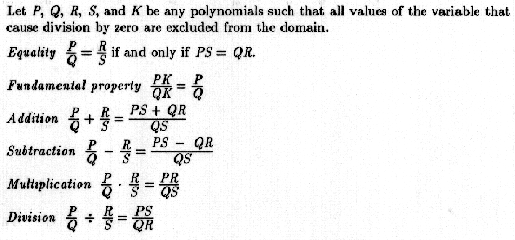
Property of
zero AB = 0 if and only if A = 0 or B = 0 (or both).
Also called the zero-product rule.
Proportion
A statement of equality between two ratios. For example,
a/b = c/d
For this proportion, a and d are called
the extremes; b and c are called the
means.
Protractor A device used
to measure angles.
Pseudosphere
The surface of revolution of a tractrix about its asymptote.
It is sometimes called a "four-dimensional sphere."
Pull-down windows
In many computer programs, you obtain additional information
or directions on a menu that is hidden until it is ready
to be used, at which time it is "pulled down."
Pyramid A solid
figure having a polygon as a base, the sides of which form
the bases of triangular surfaces meeting at a common vertex.
Pythagorean
theorem
If a triangle with legs a and b and hypotenuse
c is a right triangle, then
a2 + b2 = c2