Main diagonal
The entries a11 , a22,
a33, ... in a matrix.
Major axis In an ellipse,
the line passing though the foci.
Majority rule
Voting to find an alternative which receives more than 50%
of the vote.
Majority Criterion
If a candidate receives a majority of first-place votes,
then that candidate should be declared the winner.
Marriage A pairing
of one couple each taken from a separate group. A marriage
is stable if each partner is satisfied with the pairing
and unstable if one or the other (or both) would prefer
to be paired with another.
Mass In this course,
it is the amount of matter an object comprises. Formally,
it is a measure of the tendency of a body to oppose changes
in its velocity.
Mathematical
expectation A calculation defined as the product
of an amount to be won and the probability that it is won.
If there is more than one amount to be won, it is the sum
of the expectations of all the prizes. It is also called
the expected value or expectation.
Mathematical
modeling An iterative procedure that makes assumptions
about real-world problems to formulate the problem in mathematical
terms. After the mathematical problem is solved, it is tested
for accuracy in the real world, and revised for the next
step in the iterative process.
Mathematical
system A set with at least one defined operation
and some developed properties.
Matrix A rectangular
array of terms called elements.
Matrix equation
An equation whose elements are matrices.
Maximum loan
In this book, it refers to the maximum amount of loan that
can be obtained for a home with a given amount of income
and a given amount of debt. To find this amount, use the
present value of an annuity formula.
Mean
The number found by adding the data and dividing by the
number of values in the data set.
Means See Proportion.
Measure Comparison
to some unit recognized as standard.
Measures
of central tendency Refers to the averages of mean,
median, and mode.
Measures
of dispersion Refers to the measures of range, standard
deviation, and variance.
Measures
of position Measures that divide a data set by position,
which include median, quartiles, deciles, and percentiles.
Median The middle
number when the numbers in the data are arranged in order
of size. If there are two middle numbers (in the case of
an even number of data values), the median is the mean of
these two middle numbers.
Member See Set.
Meter The basic
unit for measuring length in the metric system.
Metric system
A decimal system of weights and measures in which the gram,
the meter, and the liter are the basic units of mass, length,
and capacity, respectively. One gram is the mass of
one cm3 of water and one liter is the same as
1,000 cm3. In this book, the metric system
refers to SI metric system as revised in 1960.
Micrometer
One millionth of a meter, denoted by m.
Mile A unit of linear
measurement in the United States system that is equal to
5,280 ft.
Milli- A prefix
that means 1/1,000.
Milligram 1/1,000
of a gram.
Milliliter
1/1,000 of a liter.
Millimeter
1/1,000 of a meter.
Million
A name for 106 = 1,000,000.
Minicomputer An everyday
name for a personal computer.
Minor axis
In an ellipse, the axis perpendicular to the major axis
passing though the center of the ellipse.
Minimum
Spanning Tree A spanning tree for which the sum
of the numbers with the edge is a minimum.
Minus
Refers to the operation of subtraction. The symbol " - "
means minus only when it appears between two numbers, two
variables, or between numbers and variables.
Mixed
number
A number that has both a counting number part and a proper
fraction part; for example
3 1/2.
Mode The value in a data set
that occurs most frequently. If no number occurs more than
once, there is no mode. It is possible to have more than
one mode.
Modem A device
connected to a computer that allows the computer to communicate
with other computers using electric cables or phone lines.
Modified Quotient
Adjust the standard divisor so that the desired number of
seats are used. This adjusted number is known as the modified
quotient.
Modular codes
A code based on modular arithmetic.
Modulo 5 A mathematical
system consisting of five elements having the property that
every number is equivalent to one of these five elements
if they have the same remainder when divided by 5.
Modulo n A mathematical
system consisting of n elements having the property that
every number is equivalent to one of these n elements if
they have the same remainder when divided by n .
Modus ponens
Same as direct reasoning.
Modus tollens
Same as indirect reasoning.
Monitor An output
device for communicating with a computer. It is similar
to a television screen.
Monomial A polynomial
with one and only one term.
Monotonicity
Criterion A candidate who wins a first election
and then gains additional support, without losing any of
the original support, should also win a second election.
Monthly compounding
In the compound interest formula, it is when n =
12.
Monthly payment
In an installment application, it is a periodic payment
that is made once every month.
Mortgage An
agreement, or loan contract, in which a borrower pledges
a home or other real estate as security.
Mouse A small plastic
"box" usually with two buttons on top and a ball on the
bottom so that it can be rolled around on a pad. It is attached
to the computer by a long cord and is used to take over
some of the keyboard functions.
Multiple See
Divisibility.
Multiplication
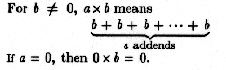
Multiplication
law of equality If a = b, then ac
= bc . Also called the multiplication property
of equality or a fundamental property of equations.
Multiplication
law of exponents
To raise a power to a power, multiply the exponents.
That is, (bn)m = bmn.
Multiplication
law of inequality
1. If a > b and c > 0, then ac
> bc.
2. If a > b and c <
0, then ac < bc.
Multiplication
law of logarithms
The log of the pth power of a number is p
times the log of that number.
In symbols,
logbAp = p logbA
Multiplication
of integers If the integers to be multiplied both
have the same sign, the result is positive and the magnitude
of the answer is the product of the absolute values of the
integers. If the integers to be multiplied have opposite
signs, the product is negative and has magnitude equal to
the product of the absolute values of the given integers.
Finally, if one or both of the given integers is 0, the
product is 0.
Multiplication
of matrices
Let [M] be an M x r matrix and [N] an r
x n matrix. The product matrix [M][N] = [P]
is an M x n matrix. The entry in the
ith row and jth column of [M][N] is the sum
of the products formed by multiplying each entry of the
ith row of [M] by the corresponding element in the
jth column of [N].
Multiplication
of rational numbers

Multiplication
principle In a numeration system, multiplication
of the value of a symbol by some number. Also, see Fundamental
counting principle.
Multiplication
property (of equations) Both sides of an equation
may be multiplied or divided by any nonzero number to obtain
an equivalent equation.
Multiplication
property of inequality
Both sides of an inequality may be multiplied or divided
by a positive number, and the order of the inequality will
remain unchangeD. The order is reversed if both sides are
multiplied or divided by a negative number. That is,
if a < b then ac < bc
if c > 0 and
ac > bc if c < 0. This
also applies to >, >=, and <=.
Multiplication
property of probability
If events E and F are independent events,
then we can find the probability of an intersection as follows:
P(E and F) = P(E)P(F)
Multiplicative
identity
The number 1, with the property that (1)a = a
for any real number a.
Multiplicative inverse
(1) See Reciprocal.
(2) If [A] is a square matrix and if there exists a matrix
[A]-1 such that
[A]-1[A] = [A][A]-1 = [I]
where [I] is the identity
matrix for multiplication, then [A]-1 is
called the inverse of
[A] for multiplication.
Multiplicity
If a root for an equation appears more than once, it is
called a root of multiplicity. For example,
(x - 1)(x - 1)(x - 1)(x - 2)(x
- 2)(x - 3) = 0
has roots 1, 2, and 3. The root 1 has multiplicity
three and root 2 has multiplicity two.
Mutually exclusive
Events are mutually exclusive if their intersection is empty.