Identity
(1) A statement of equality that is true for all values
of the variable. It also refers to a
number I so that
for some operation o, I o a = a o I
= a for every number a in a given
set.
(2) An open equation that is true for all replacements of
the variable.
Identity matrix A
matrix satisfying the identity property. It is a square
matrix consisting of ones along the main diagonal and zeros
elsewhere.
If-then In symbolic
logic, it is a connective also called implication. In BASIC
computer language, IF-THEN is a branching command that will
conditionally transfer from one place in a program to another
place.
Implication
A statement that follows from other statements. It
is also a proposition formed from two given propositions
by connecting them with an "if..., then ... " form.
Impossible event
An event for which the probability is zero; that is, an
event that cannot happen.
Improper fraction
A fraction for which the numerator is greater than the denominator.
Improper subset
See Subset.
Inch

Inclusive or
This is the same as disjunction. The compound statement
"p or q " is called the inclusive or.
Inconsistent
system A system for which no replacements of the
variable make the equations true simultaneously.
Indefinite
integral An antiderivative.
Independence
of irrelevant alternatives If voter prefers A
to B with C as a possible choice, we assume
that the voter still prefers A to B when C
is not a possible choice.
Independent
events Events E and F are independent if the occurrence
of one in no way affects the occurrence of the other.
Independent
system A system of equations such that no one of
them is necessarily satisfied by a set of values of the
variables that satisfy all the others.
Independent
variable The variable associated with the first
component of an ordered pair.
Indirect reasoning

Inductive
reasoning A type of reasoning accomplished by first
observing patterns and then predicting answers for more
complicated similar problems.
Inequality
A statement of order. If always true, an inequality is called
an absolute inequality; if always false, an inequality is
called a contradiction. If sometimes true and sometimes
false, it is called a conditional inequality. Values that
make the statement true are said to satisfy the inequality.
A string of inequalities may be used to show the order of
three or more quantities.
Inequality
symbols

Inferential
statistics Statistics which is concerned with making
generalizations or predictions about a population based
on a sample from that population.
Infinite series
The indicated sum of an infinite sequence.
Infinite set
See Set.
Infinity symbol

Inflation
An increase in the amount of money in circulation, resulting
in a fall in its value and a rise in prices. In this
book, we assume annual compounding with the future value
formula; that is, use A = P(1 + r)n,
where r is the projected annual inflation rate, n
is the number of years, and P is the present value.
Information retrieval
The locating and displaying of specific material from a
description of its content.
Input A method
of putting information into a computer. Input includes downloading
a program, typing on a keyboard, pressing on a pressure-sensitive
screen. In BASIC programming, it refers to a command (INPUT)
that stops a program to wait for input material.
Input device
Component of a system that allows the entry of data on a
program into a computer's memory.
Installment
loan A financial problem in which an item is paid
for over a period of time. It is calculated using add-on
interest or compound interest.
Installments
Part of a debt paid at regular intervals over a period of
time.
Instant insanity
A puzzle game consisting of four blocks with different colors
on the faces. The object of the game is to arrange
the four blocks in a row so that no color is repeated on
one side as the four blocks are rotated through 360ï.
Instantaneous rate
of change

Integers
Z = {..., -3, -2, -1, 0, 1, 2, 3, ... } is composed of the
natural numbers, their opposites, and 0.
Integral
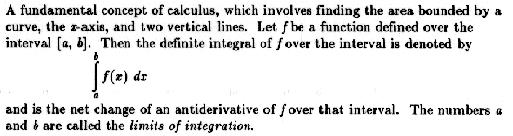
Integral calculus
That branch of calculus that involves applications of the
integral.
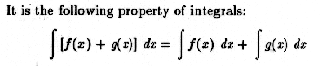
Integral of
a sum
Integrand In
an integral, it is the function to be integrated.
Integrated
circuit The plastic or ceramic body that contains
a chip and the leads connecting it to other components.
Interactive
Software that allows continuous two-way communication between
the user and the program.
Intercept form

Intercepts
The point or points where a line or a curve crosses a coordinate
axis. The x-intercepts are sometimes called the zeros of
the equation.
Interest An
amount of money paid for the use of another's money. See
Compound interest.
Interest only
loan A loan in which periodic payments are for
interest only so that the principal amount of the loan remains
the same.
Interest rate
The percentage rate paid on financial problems. In this
book it is denoted by r and is assumed to be an annual rate
unless otherwise stated.
Interface
The electronics necessary for a computer to communicate
with a peripheral.
Internet A network
of computers from all over the world which are connected
together. It can be accessed through institutions or servers
such as America Online, Compuserve, or Prodigy.
Intersection

Interval See
Classes.
Invalid argument
An argument that is not valid.
Inverse
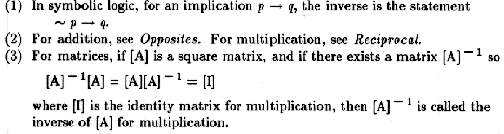
Inverse Cosine
See Inverse trigonometric ratios
Inverse Sine
See Inverse trigonometric ratios
Inverse Tangent
See Inverse trigonometric ratios
Inverse property
For each real number a there is a unique real number
-a, called the opposite (or additive inverse)
of a, so that
a + (-a) = -a + a = 0
Inverse trigonometric
ratios
The inverse sine, inverse cosine, and inverse tangent, are
the inverse trigonometric ratios. For t
an acute angle in a right triangle,
sin-1(opp/hyp) = t;
cos-1(adj/hyp) = t;
tan-1(opp/adj) = t
Invert In relation to the fraction
a/b, it means to interchange the numerator and the
denominator to obtain the fraction b/a.
Irrelevant
alternatives criterion If a candidate is declared
the winner of an election, and in a second election one
or more of the other candidates is removed, then the previous
winner should still be declared the winner
Irrational
number
A number that can be expressed as a nonrepeating, nonterminating
decimal.
Isosceles triangle
A triangle with two sides the same length.
Isosceles
triangle property If two sides of a triangle
have the same length, then angles opposite them are equal.