Calculus The
field of mathematics that deals with differentiation and
integration of functions, and related concepts and applications.
Canceling The
process of reducing a fraction by dividing the same number
into both the numerator and the denominator.
Canonical form
When a given number is written as a product of prime factors
in ascending order, it is said to be in canonical form.
Capacity A measurement
for the amount of liquid a container holds.
Cardinal number
A number that designates the manyness of a set; the number
of units, but not the order in which they are arranged.
Cardinality
The number of elements in a set.
Cards A deck of
52 matching objects that are identical on one side and on
the other side are divided into four suits (hearts, diamonds,
spades, and clubs). The objects, called cards, are labeled
A, 2, ... , 9, 10, J, Q, and K in each suit.
Cartesian
coordinate system Two intersecting lines, called
axes, used to locate points in a plane called a Cartesian
plane. If the intersecting lines are perpendicular, the
system is called a rectangular coordinate system.
Cartesian plane
See Cartesian coordinate system.
CD-ROM A form
of mass storage. It is a cheap read-only device, which means
that you can only use the data stored on it when it was
created, but it can store a massive amount of material,
such as an entire encyclopedia.
Cell A specific
location on a spreadsheet. It is designated using a letter
(column heading) followed by a numeral (row heading). A
cell can contain a letter, word, sentence, number, or formula.
Celsius
A metric measurement for temperature for which the freezing
point of water is zero degrees and the boiling point of
water is one hundred degrees.
Center See Circle.
Center of
an ellipse The midpoint of the line segment connecting
the foci of the ellipse.
Center
of a hyperbola The midpoint of the line segment
connecting the foci of the hyperbola.
Centi- A prefix
that means 1/100.
Centigram One
hundredth of a gram.
Centiliter
One hundredth of a liter.
Centimeter
One hundredth of a meter.
Change
of base theorem logbx =
logbx/logba
Ciphertext A secret or coded
message.
Circle The set
of points in a plane that are a given distance from a given
point. The given point is called the center, and the given
distance is called the radius. The diameter is twice the
radius. The unit circle is the circle with center at (0,
0) and r = 1.
Circle graph
See Graph.
Circuit A complete
path of electrical current including a power source and
a switch. It may include an indicator light to show when
the circuit is complete.
Circular
definition A definition that relies on the use
of the word being defined, or other words that rely on the
word being defined.
Circumference
The distance around a circle. The formula for finding the
circumference is C = (pi)D or
C = 2(pi)r.
Classes One of the groupings when
organizing data. The difference between the lower limit
of one class and the lower limit of the next class is called
the interval of the class. The number of values within a
class is called the frequency.
Closed See Closure
property.
Closed curve
A curve that has no endpoints.
Closed-ended
loan An installment loan.
Closed half-plane
See Half-plane.
Closed network
A network that connects each point.
Closed set
A set that satisfies the closure property for some operation.
Closing The
process of settlement on a real estate loan.
Closing costs
Costs paid at the closing of a real estate loan.
Closure property
A set S is closded for an operation o if a
o b is an element of S for all elements
a and b in S. This property is
called the closure property.
Code The lines
of a program are referred to as code. One refers to part
of the program as "a block of code," or to the program in
programming language as "source code," or finally to the
compiled program as "object code."
Coefficient
Any factor of a term is said to be the coefficient of
the remaining factors. The numerical coefficient
is the numerical part of the term, usually written before
the variable part. In 3x, it is the number
3, in 9x2y3 it is the
number 9. Generally, the word coefficient is
taken to be the numerical coefficient of the variable factors.
Column A vertical arrangement of
numbers or entries of a matrix. It is denoted by letters
A, B, C, ... on a spreadsheet.
Combination

Command A single
instruction to prompt a computer to perform a specific predefined
operation.
Common denominator
For two or more fractions, a common multiple of the denominators.
Common difference
The difference between successive terms of an arithmetic
sequence.
Common factor
A factor that two or more terms of a polynomial have in
common.
Common fraction
Fractions written in the form of one integer divided
by a whole number are common fractions. For example, 1/10
is common fraction representation and 0.1 is the decimal
representation of the same number.
Common logarithm
A logarithm to the base 10; written log N .
Common ratio
The ratio between successive terms of a geometric sequence.
Communication
matrix A square matrix in which the entries symbolize
the occurrence of some facet or event with a 1 and the nonoccurrence
with a 0.
Communications
package A program that allows one computer to communicate
with another computer.
Commutative
group
A group that also satisfies the property that
a o b = b o a
for some operation o and elements a and b
in the set.
Commutative property
A property of order that applies to certain operations (addition
and multiplication, for example, but not to subtraction
and division). If a and b are real numbers, then a
+ b = b + a and ab = ba.
Comparison
property
For any two numbers x and y, exactly one of
the following is true:
(1) x = y; x is equal to y (the
same as)
(2) x > y; x is greater than y (bigger
than)
(3) x < y; x is less than y (smaller
than).
This is sometimes known as the trichotomy property.
Comparison
rate for home loans
A formula for comparing terms of a home loan.
The formula is
APR + 0.125( POINTS
+ ORGINATION FEE/ AMOUNT
OF LOAN)
Compass An instrument for
scribing circles or for measuring distances between two
points.
Compiler An
operating system program that converts an entire program
written in a higher-level language into machine language
before the program is executed.
Complement
(1) Two numbers less than 1 are called complements if their
sum is 1.
(2) The complement of a set is everything not in the set
relative to a given universe.
Complementary
angles Two angles are complementary if the sum of
their measures is 90¥.
Complementary
probabilities
P(E) = 1 - P(E); that is, two
probabilities are complementary if P(E)
+ P(E comp) = 1.
Completely factored
An expression is completely factored if it is a product
and there are no common factors and no difference of squares;
that is, if no further factoring is possible.
Complex decimal
A form that mixes decimal and fractional form, such
as 0.12 1/2.
Complex fraction
A rational expression a/b where a
or b (or both) have fractional form.
Components
See ordered pair.
Composite number
Sometimes simply referred to as a composite; it is a positive
integer that has more than two divisors.
Compound interest
A method of calculating interest by adding the interest
to the principal at the end of the compounding period so
that this sum is used in the interest calculation for the
next period.
Compound
interest formula
A = P(1 + i)N, where
A = future value;
P = present value (or principal);
r = annual interest rate (APR);
t = number of years;
n = number of times compounded per year;
i = r/n; and
N = nt.
Compound statement
A statement formed by combining simple statements with one
or more operators.
Compounding
The process of adding interest to the principal so that
in the next time period the interest is calculated on this
sum.
Computer A
device which, under the direction of a program, can process
data, alter its own program instructions, and perform computations
and logical operations without human intervention.
Computer abuse
A misuse of a computer.
Computer program
A set of step-by-step directions that instruct a computer
how to carry out a certain task.
Conclusion
The statement that follows (or is to be proved to follow)
as a consequence of the hypothesis of the theorem. Also
called a logical conclusion.
Conditional

Conditional
equation See Equation.
Conditional
inequality See Inequality.
Conditional
probability
A probability that is found on the condition that a certain
event has occurred.
The notation P(E | F) is the proability of
an event E on the condition that event F
has occurreD.
Condorcet's
paradox
There are three citizens, A, B, and C, and
each citizen ranks three different policies
as shown:
A: x > y > z
B: y > z > x
C: z > x > y
Then two citizens prefer x to y, two prefer
y to z, and two prefer z to x,
which is not transitivE. Each voter is consistent, but the
social choice is inconsistent. This is known as Codorcet's
paradox.
Condorcet
candidate The candidate who wins th one-to-one matchups.
Condorcet
criterion If a candidate is favored when compared
one on one with every other candidate, then the candidate
should be declared the winner.
Cone A solid with
a circle for its base and a curved surface tapering evenly
to an apex so that any point on this surface is in a straight
line between the circumference of the base and the apex.
Congruent Of
the same size and shape; if one is placed on top of the
other, the two figures will coincide exactly in all their
parts.
Congruent angles
Two angles that have the same measure.
Congruent modulo
M
Two real numbers a and b are congruent
modulo m if a and b differ by a
multiple of m.
Congruent triangles
Two triangles that have the same size and shape.
Conic sections
The set of points that results from the intersection of
two three-dimensional objects (a cone and a plane) is a
two-dimensional curve known as a conic section. The conic
sections include the parabola, ellipse (special case, circle),
and hyperbola.
Conjecture
A guess or prediction based on incomplete or uncertain evidence.
Conjugate axis
The line passing through the center perpendicular to the
transverse axis of a hyperbola.
Conjunction
The conjunction of two simple statements p and q
is true whenever both p and q are true, and
is false otherwise. The common translation of conjunction
is "and."
Connected network
A network that connects each point.
Connective
A rule that operates on one or two simple statements. Some
examples of connectives are and, or, not, unless, ... .
Consecutive
integers Integers that differ by 1.
Consequent
See Conditional.
Consistent
system If a system of equations has at least one
solution, it is consistent; otherwise it is said to be inconsistent.
Constant Symbol
with exactly one possible value.
Constant function
A function of the form f (x) = c.
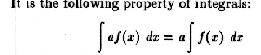
Constant multiple
Constraint
A limitation placed on an objective function. See Linear
programming.
Construct The
process of drawing a figure that will satisfy certain given
conditions.
Contained
in a set An element is contained in a set if it
is a member of the set.
Continuous
compounding
If we let the number of compounding periods in a year increase
without limit, the result is called continuous compounding.
The formula is
A = Pert
For a present value of P, the future value
A at a rate of r for t years.
Continuous
distribution A probability distribution that includes
all x-values (as opposed to a discrete distribution,
which allows a finite number of x -values).
Contradiction
An open equation for which the solution set is empty.
Contrapositive

Converge
To draw near to. A series is said to converge with
the sum of the first n terms approaches a limit as
n increases without bounD. We say that the sequence
converges to a limit L if the values of the successive
terms of the sequence get closer and closer to the number
L as n becomes infinitely large.
Converse

Convex set
A set that contains the line segment joining any two of
its points.
Coordinate plane
See Cartesian coordinate system.
Coordinates
A numerical description for a point. Also see Ordered pair.
Correlation
The interdependence between two sets of numbers. It is a
relationship between two quantities, such that when one
changes the other does (simultaneous increasing or decreasing
is called positive correlation; and one increasing, the
other decreasing, negative correlation).
Corresponding
angles Angles in different triangles that are similarly
related to the rest of the triangle.
Corresponding
parts Points, angles, lines, etc., in different
figures, similarly related to the rest of the figures.
Corresponding
sides Sides of different triangles that are similarly
related to the rest of the triangle.
Cosine
In a right triangle ABC with right angle C,
cos A = ADJACENT SIDE OF A/ HYPOTENUSE
Countable Set
A set with cardinality aleph null. That is, a set that can
be placed into a one-on-one correspondence with the set
of counting numbers.
Count-down
Property n! = n(n - 1)!
Counterclockwise
In the direction of rotation opposite to that in
which the hands move around the dial of a clock.
Counterexample
An example that is used to disprove a proposition.
Counting numbers
See Natural numbers.
CPU Central Processing
Unit, the primary section of the computer that contains
the memory, logic, and arithmetic procedures necessary to
process data and perform computations. The CPU also controls
the functions performed by the input, output, and memory
devices.
Credit card
A card signifying that the person or business issued the
card has been approved open-ended credit. It can be used
at certain restaurants, airlines, and stores accepting that
card.
Cryptography
The writing or deciphering of messages in code.
Cube
(1) A solid with six equal square sides.
(2) In an expression such as x3, which is
pronounced "x cubed;" it means xxx.
Cube root See Root of a number.
Cubed See Cube.
Cubic unit
A three-dimensional unit. It is the result of cubing a unit
of measurement.
Cumulative
frequency A frequency that is the total number of
cases having any given score or a score that is lower.
Cup A unit of measurement
in the United States measurement system that is equivalent
to 8 fluid ounces.
Cursor Indicator
(often flashing) on a computer or calculator display to
designate where the next character input will be placed.
Cylinder Suppose
we are given two parallel planes and two simple closed curves
C and D in these planes for which lines joining
corresponding points of C and D are parallel to a given
line L. A cylinder is a closed surface consisting
of two bases that are plane regions bounded by such curves
C and D and a lateral surface that is the
union of all line segments joining corresponding points
of C and D .
Cyphertext
A secret or coded message.