Balinski
and Young's Impossibility Theorem Any apportionment
plan that does not violate the quota rule must produce paradoxes.
And any apportionment method that does not produce paradoxes
must violate the quota rule.
Balloon payment
A single, larger payment made at the end of the
time period of an installment loan that is not amortized.
Bar graph See
Graph.
Base (1) See Exponent.
(2) In a percent problem, it is the whole quantity.
Base angles
In an isosceles triangle, the angles formed by the base
with each of the equal sides.
Base
b numeration system A numeration system with
b elements.
Base of
an exponential
In y = bx , the base is b
(b not equal to 1).
Base of a
triangle In an isosceles triangle, the side that
is not the same length as the sides whose lengths are the
same.
BASIC Beginner's
All-purpose Symbolic Instruction Code; it is a higher-level
computer language common to most microcomputers.
Because

Bell-shaped
curve See Normal curve.
Belong to a set
To be an element of a set.
Bernoulli trial
A Bernoulli trial is an experiment that meets four conditions:
- There must be a fixed number of trials. Denote this
number by n.
- There must be two possible mutually exclusive outcomes
for each trial. Call them success and failure.
- Each trial must be independent. That is, the outcome
of a particular trial is not affected by the outcome of
any other trial.
- The probability of success and failure must remain constant
for each trial.
Biconditional
A logical operator for simple statements p and q that is
true when p and q have the same truth values, and is false
when p and q have different truth values.
Billion
A name for 109 = 1,000,000,000
Bimodal A distribution with
two modes.
Binary
numeration system A numeration system with two numerals,
0 and 1.
Binary voting
Selecting a winner by pairing two competitors and then pairing
up the winners to select the final victor.
Binomial A polynomial
with exactly two terms.
Binomial
Distribution Theorem
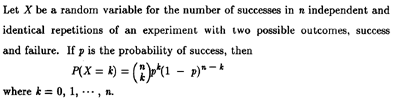
Binomial
Experiment A binomial experiment is an experiment
that meets four conditions:
- There must be a fixed number of trials. Denote this
number by n.
- There must be two possible mutually exclusive outcomes
for each trial. Call them success and failure.
- Each trial must be independent. That is, the outcome
of a particular trial is not affected by the outcome of
any other trial.
- The probability of success and failure must remain constant
for each trial.
Binomial
Random Variable random variable associated with
an experiment having exactly two outcomes.
Binomial theorem

Birthday problem
The probability that two unrelated people will have their
birthdays on the same day (not counting the year of birth).
Bisect To divide
into two equal or congruent parts.
Bit Binary digit,
the smallest unit of data storage with a value of either
0 or 1, thereby representing whether a circuit is open or
closed.
Bond An interest-bearing
certificate issued by a government or business, promising
to pay the holder a specified amount (usually $1,000) on
a certain date.
Boot To start a
computer. To do this the computer must have access to an
operating system on a floppy disk or hard disk.
Borda count
A common way of determining a winner when there is no majority
is to assign a point value to each voter's ranking.
If there are n candidates, then n points are
assigned to the first choice for each voter, with n
- 1 points for the next choice, and so on.
The points for each candidate are added and if one has more
votes, that candidate is declared the winner.
Boundary See Half-plane.
Box plot A rectangular
box positioned above a numerical scale associated with a
given set of data. It shows the maximum value, the minimum
value, and the quartiles for the data.
Braces See Grouping
symbols.
Brackets See
Grouping symbols.
Branch In BASIC
programming, a branch is a means of transferring from one
point in a program to another under certain conditions.
In particular, it refers to the IF-THEN and IF-ELSE commands.
Bug An error in the
design or makeup of a computer program (software bug) or
a hardware component of the system (hardware bug).
Bulletin boards
An online means of communicating with others on a particular
topic.
Byte The fundamental
block of data that can be processed by a computer. In most
microcomputers, a byte is a group of eight adjacent bits
and the rough equivalent of one alphanumeric symbol.